dimanche 3 juin 2012

MEET THE KNOBBERS 2012

 
Facebook
http://meettheknobbers.com

Monkeys + Synthesizers


Composer and Swedish dance music maestro Håkan Libdo has been a constant source of experimentation. But his latest project yields zoo-like new adventurousness. Six species of monkeys are equipped with synthesizers to test the question of whether playing a synth is really playing music – or if it’s so simple, a monkey can do it.

http://hakanlidbo.com

Kinect + Digital Camera = DIY CGI


Kaley says: “The team behind the RGB+D Toolkit (an open-source, video game/Final Cut Pro hybrid) is attempting to transform the Kinect gaming console into a real filmmaking tool, making stunning DIY CGI a real possibility. Using a Kinect and a standard DSLR camera, like your Canon 5D, these avant-garde image-makers have created a technique that allows you to generate a true CGI and video hybrid. The results are pretty striking.”

mercredi 30 mai 2012

Motherboard TV: Morton Subotnick, Father of Electronic Music


"What kind of music would robots make? Blips and bloops, most likely, with a whole lot of abstract tones and soundwave manipulation. You know, droning stuff that sounds like auditory binary. I mean, come on. How musical could a robot be?

Such were the early days of electronic music, whose early proponents put much more emphasis on the “electronic” than the “music.” That’s not to denigrate the incredible complexity of wave generators or tiny bits of tape spliced together on splicing blocks. It’s just to point out that what we see as electronic music today was once well and truly the sound of electronics themselves.

So who’s responsible for turning the electro tide towards real music? Why, Morton Subotnick of course.

As is often the case in music, it was a bicoastal thing: Subotnick, Ramon Sender, and Don Buchla spent the 60s in San Francisco developing what may be the world’s first analog synthesizer, the ‘electronic music easel’ BUCHLA 100, while Robert Moog was putting together his incredible keyboard on the East Coast.

BUCHLA 100 was brilliant because, instead of a keyboard, it relied on pressure sensitive touch-plates. Those controlled keys that could be individually tuned, allowing for an unlimited number of sound-producing possibilities. It freed musicians from the sine, sawtooth, and square bonds of the past, and allowed electronic music to flourish.

Subotnick himself was the first to put his creation through its creative paces. Recorded over the span of a year in New York, his album Silver Apples of the Moon stands as the first all-electronic LP, and effectively declared the era of computer music dead. The album has since been inducted into the Library of Congress.

As part of our Electric Independence series, in 2011 we paid a visit to Subotnick at his Lower East Side studio to chat about the past and future of electronic music. Remember one thing the next time you’re in a club with some cyborg DJ poking away at a booth full of weird gadgets: If it wasn’t for Subotnick, you’d be stuck listening to robot chatter."

lundi 28 mai 2012

NSFW: iVardensphere's Interesting View On Music Gear


"Join me while I go over some of the instruments iVardensphere uses in the studio. Of course just having Scott talk to the camera would be boring and we certainly don't want that so we asked some friends to help complete the vision."

@iVardensphere 

Synchronous Dissections


Video below is the result of a workshop held last week at SCI-Arc teaching students about synchronous robotics. We already covered SCI-Arc robotics here, but the results this time are bullet time light drawings which instead of being constrained to a bullet time camera rig have the freedom to be viewed from any perspective.
LEDs are attached to corners and centres of the panels whereas the DSLR camera is attached to one of the robotic arms. As the panels move in sync, the camera takes pictures of LED paths. No video editing was done to the light drawings, simply a series of still images. Below is also the original proof of concept for the workshop.
Robot Control Software: esperantorobotics.com
Research Institution: sciarc.eduestm.us
Instructors: Brandon Kruysman & Jonathan Proto thecognomen.net

vendredi 25 mai 2012

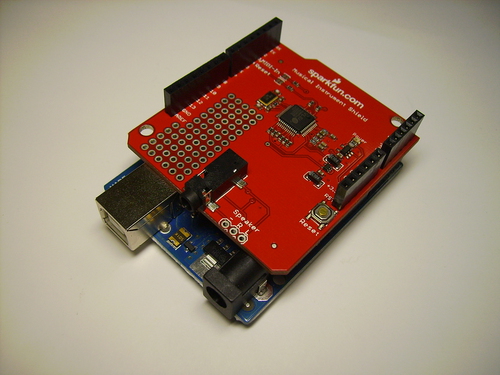
Musical Instrument Shield


Believe it or not, the small chip on the Music Instrument Shield is capable of generating thousands of different sounds. Ever played with a Casio (or other brand) synthesizer at a department store? The VS1053 chip on the Musical Instrument Shield can make just as many sounds!

http://www.sparkfun.com/tutorials/302